
Voronoi Presents Clinical Data on Key Pipeline Programs at AACR-NCI-EORTC 2025
2025.10.24
■ A total of four poster presentations, including Phase 1 clinical data on VRN11 and VRN10
■ VRN11 demonstrates high blood-brain-barrier penetration and excellent safety
Voronoi announced on the 23rd (local time in Boston, U.S.) that it has presented clinical data on VRN11 at the AACR-NCI-EORTC International Conference 2025, a global conference co-hosted by the American Association for Cancer Research (AACR), the National Cancer Institute (NCI), and the European Organisation for Research and Treatment of Cancer (EORTC).
At the conference, held in Boston from October 22 to 26, Voronoi is disclosing the Phase 1 results of VRN11 and VRN10 in the form of poster presentations, and also presented the clinical study overviews (Trial in Progress) for VRN11 and VRN10.
According to the key VRN11 clinical results disclosed this time, a partial response (PR) was observed in 3 of 4 (75%) EGFR C797S mutation non-small cell lung cancer patients.
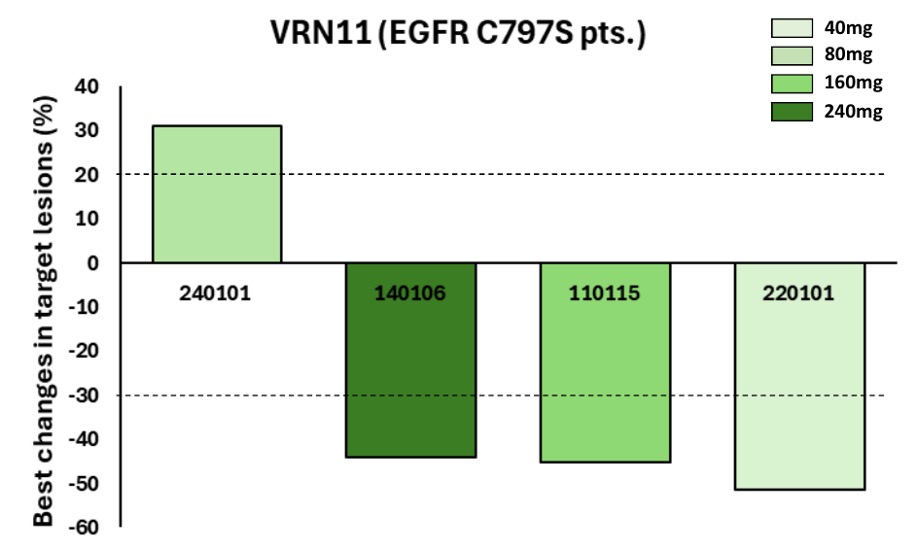
Image source: Voronoi (AACR-NCI-EORTC 2025)
In addition, disease control (disease control rate, DCR) was confirmed in all 11 (100%) patients with brain metastases (BM) or leptomeningeal metastases (LM), demonstrating VRN11's excellent therapeutic effect in patients with brain metastases. In particular, Kpuu,CSF was measured at 200% in a brain metastasis patient dosed at 240 mg, reproducing in the clinic the high blood-brain-barrier (BBB) penetration confirmed in preclinical studies. Positive results were also confirmed in terms of safety. Not a single case of a Grade 3 or higher drug-related adverse event was reported among the total of 54 patients dosed up to 400 mg, and excellent tolerability was maintained even in patients on long-term dosing of 10 months or more.
Furthermore, clinical efficacy was also confirmed in the group of non-small cell lung cancer patients with the most frequent EGFR mutations (EGFR Del19, EGFR L858R) who were refractory to first- to third-generation EGFR targeted therapies. The company explained that while the existing drug Tagrisso (osimertinib) has a median progression-free survival (mPFS) of about 4 months in EGFR T790M-negative patients, 18 of 21 patients on VRN11 were continuing treatment as of the data cutoff, so an mPFS exceeding that of Tagrisso is expected.
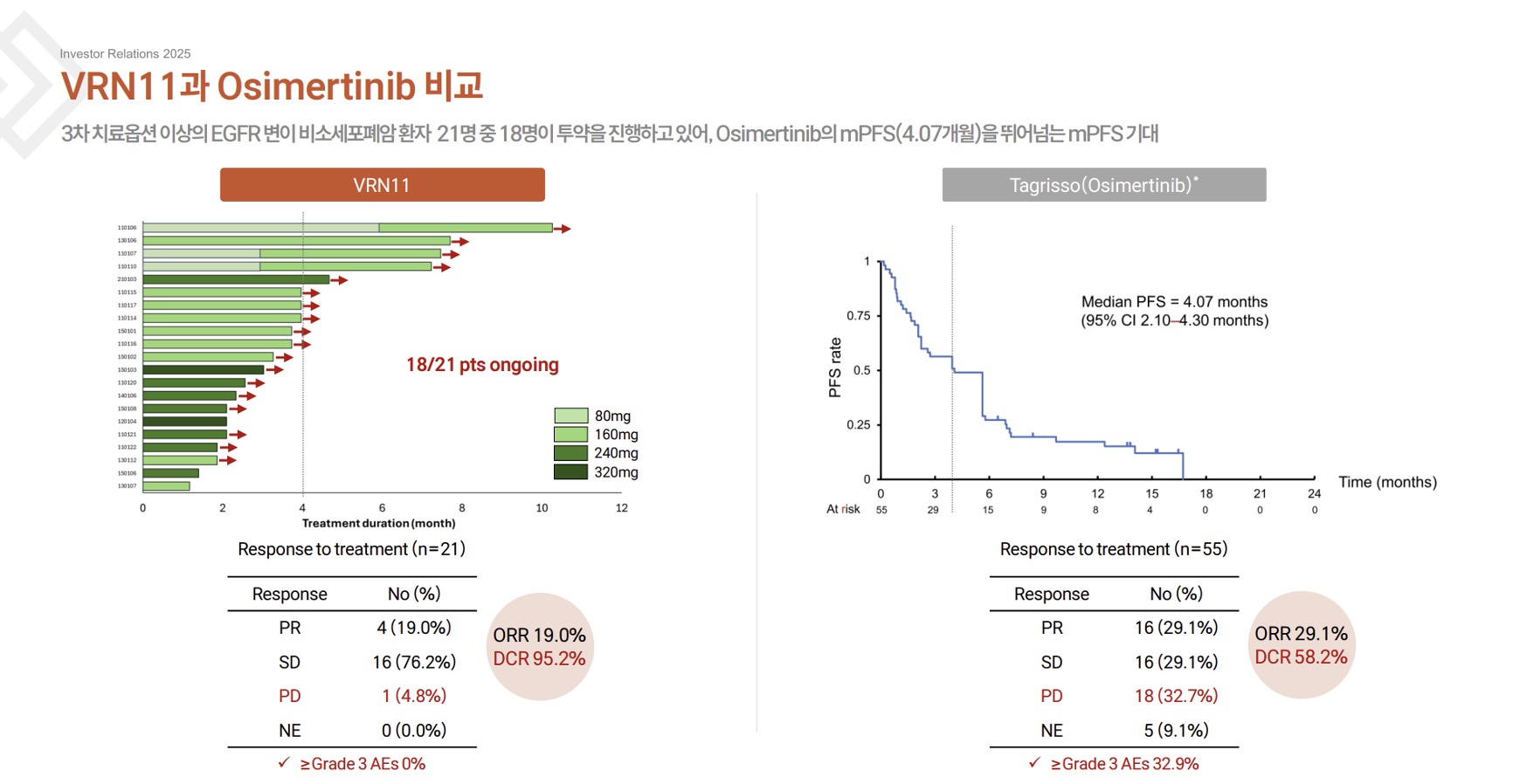
Image source: Voronoi website
Based on these encouraging results, Voronoi plans to proceed with a Phase 1b/2 cohort in patients with the EGFR C797S mutation. As there is currently no approved therapy for non-small cell lung cancer patients with the EGFR C797S mutation, the company intends to continue development with the goal of accelerated approval based on Phase 2 results.
In addition, in the upcoming Phase 1b/2 trial, a cohort of treatment-naïve patients with primary EGFR mutations will be conducted in parallel.
■ VRN11 demonstrates high blood-brain-barrier penetration and excellent safety
Voronoi announced on the 23rd (local time in Boston, U.S.) that it has presented clinical data on VRN11 at the AACR-NCI-EORTC International Conference 2025, a global conference co-hosted by the American Association for Cancer Research (AACR), the National Cancer Institute (NCI), and the European Organisation for Research and Treatment of Cancer (EORTC).
At the conference, held in Boston from October 22 to 26, Voronoi is disclosing the Phase 1 results of VRN11 and VRN10 in the form of poster presentations, and also presented the clinical study overviews (Trial in Progress) for VRN11 and VRN10.
According to the key VRN11 clinical results disclosed this time, a partial response (PR) was observed in 3 of 4 (75%) EGFR C797S mutation non-small cell lung cancer patients.
Image source: Voronoi (AACR-NCI-EORTC 2025)
In addition, disease control (disease control rate, DCR) was confirmed in all 11 (100%) patients with brain metastases (BM) or leptomeningeal metastases (LM), demonstrating VRN11's excellent therapeutic effect in patients with brain metastases. In particular, Kpuu,CSF was measured at 200% in a brain metastasis patient dosed at 240 mg, reproducing in the clinic the high blood-brain-barrier (BBB) penetration confirmed in preclinical studies. Positive results were also confirmed in terms of safety. Not a single case of a Grade 3 or higher drug-related adverse event was reported among the total of 54 patients dosed up to 400 mg, and excellent tolerability was maintained even in patients on long-term dosing of 10 months or more.
Furthermore, clinical efficacy was also confirmed in the group of non-small cell lung cancer patients with the most frequent EGFR mutations (EGFR Del19, EGFR L858R) who were refractory to first- to third-generation EGFR targeted therapies. The company explained that while the existing drug Tagrisso (osimertinib) has a median progression-free survival (mPFS) of about 4 months in EGFR T790M-negative patients, 18 of 21 patients on VRN11 were continuing treatment as of the data cutoff, so an mPFS exceeding that of Tagrisso is expected.
Image source: Voronoi website
Based on these encouraging results, Voronoi plans to proceed with a Phase 1b/2 cohort in patients with the EGFR C797S mutation. As there is currently no approved therapy for non-small cell lung cancer patients with the EGFR C797S mutation, the company intends to continue development with the goal of accelerated approval based on Phase 2 results.
In addition, in the upcoming Phase 1b/2 trial, a cohort of treatment-naïve patients with primary EGFR mutations will be conducted in parallel.