
Voronoi's 'Next-Generation Lung Cancer Targeted Therapy VRN11' Records 100% Objective Response Rate in EGFR C797S-Resistant Patients
2026.04.20
■ Tumor shrinkage in all C797S-resistant patients dosed at or above the effective dose (160 mg)... 96.8% disease control also confirmed in EGFR mutation patients
■ Improved efficacy and safety versus existing therapies demonstrated... Entry into the first-line treatment market coming into view
Voronoi (310210, CEOs Daekwon Kim and Hyuntae Kim), a company specializing in the development of precision targeted anticancer drugs, has released overwhelming clinical data on its next-generation lung cancer targeted therapy 'VRN11,' demonstrating its potential as a game changer that overcomes the limitations of existing therapies.
On the 17th (local time), at the American Association for Cancer Research Annual Meeting (AACR 2026) held in San Diego, U.S., Voronoi presented, in a poster presentation, significant Phase 1 results in patients with EGFR C797S, the representative resistance mutation that arises after taking Tagrisso (osimertinib), a third-generation EGFR inhibitor.
■ Response in all patients dosed at the effective dose... An alternative for overcoming Tagrisso resistance
According to the presentation, a partial response (PR), with tumor size reduced by 30% or more, was confirmed in 7 of 8 EGFR C797S mutation non-small cell lung cancer patients with prior experience of multiple targeted therapies. In particular, all 6 patients in the group dosed at or above the effective dose of 160 mg showed a partial response, recording an encouraging 'objective response rate (ORR) of 100%.'
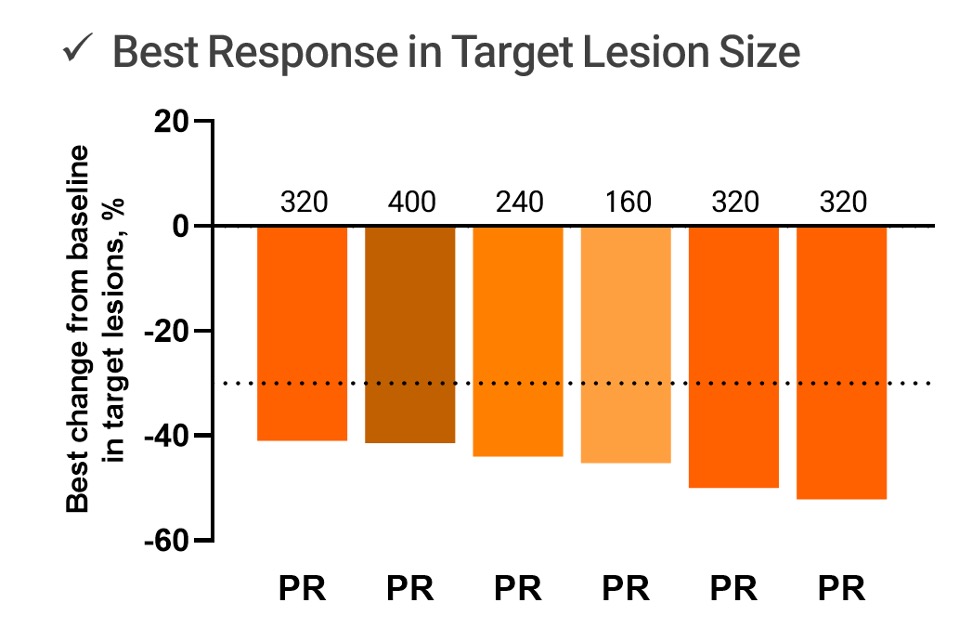
Image source: Voronoi website
In addition, consistent clinical efficacy was observed in the group of EGFR mutation non-small cell lung cancer patients refractory to first- to third-generation EGFR targeted therapies. While the existing therapy Tagrisso is known to have a median progression-free survival (mPFS) of only about 4 months in EGFR T790M-negative patients, more than half of the patients on VRN11 were continuing treatment, suggesting the possibility of exceeding existing data. Furthermore, as of the data cutoff, disease control was confirmed in 30 of the 31 patients dosed at or above the effective dose of 160 mg (DCR 96.8%), and some patients were found to be maintaining long-term dosing of more than one year.
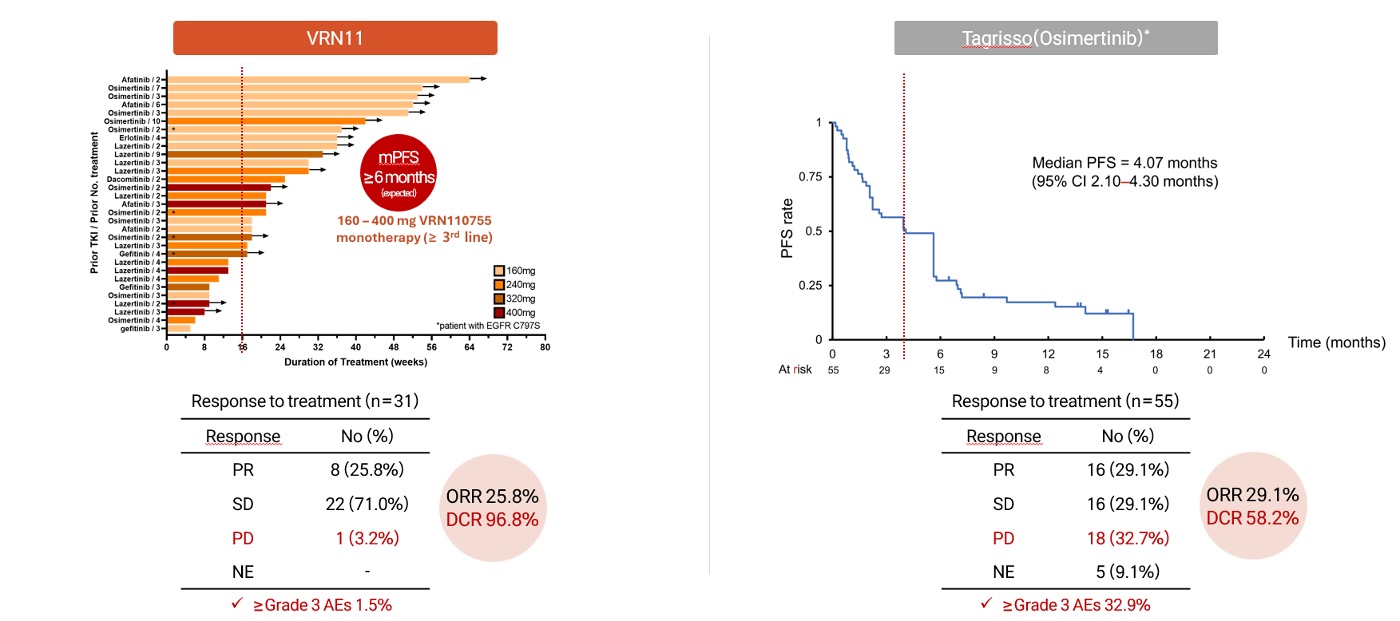
Image source: Voronoi website
■ Excellent safety confirmed even at high doses
The safety data are also unrivaled. Among the 65 patients dosed across the dose range from 10 mg to 480 mg, there was only one case of a drug-related Grade 3 or higher serious adverse event. In particular, in the group of patients dosed at high doses of 320 mg or more, no drug-related Grade 3 or higher adverse events occurred at all. Data from numerous patients on long-term dosing for nearly a year were also included, confirming the evidence for long-term use as well. This is seen as a result that overcomes the side-effect limitations of existing EGFR targeted therapies (TKIs), and is assessed as having secured competitiveness in future long-term use and combination regimens based on excellent tolerability.
Based on these results, Voronoi plans to initiate a Phase 1b/2 cohort in patients with the EGFR C797S mutation within the year. Considering the market situation in which there is currently no approved therapy, the company aims to obtain accelerated approval based on Phase 2 data.
■ Entry into the first-line treatment market coming into view
A Voronoi representative said, "This AACR presentation scientifically proves that VRN11 can offer new hope to patients with Tagrisso resistance. In the Phase 1b/2 trial to be conducted this year, we will also run a parallel cohort of treatment-naïve EGFR mutation patients and fully launch our development strategy to expand VRN11 into a first-line treatment option."
■ Improved efficacy and safety versus existing therapies demonstrated... Entry into the first-line treatment market coming into view
Voronoi (310210, CEOs Daekwon Kim and Hyuntae Kim), a company specializing in the development of precision targeted anticancer drugs, has released overwhelming clinical data on its next-generation lung cancer targeted therapy 'VRN11,' demonstrating its potential as a game changer that overcomes the limitations of existing therapies.
On the 17th (local time), at the American Association for Cancer Research Annual Meeting (AACR 2026) held in San Diego, U.S., Voronoi presented, in a poster presentation, significant Phase 1 results in patients with EGFR C797S, the representative resistance mutation that arises after taking Tagrisso (osimertinib), a third-generation EGFR inhibitor.
■ Response in all patients dosed at the effective dose... An alternative for overcoming Tagrisso resistance
According to the presentation, a partial response (PR), with tumor size reduced by 30% or more, was confirmed in 7 of 8 EGFR C797S mutation non-small cell lung cancer patients with prior experience of multiple targeted therapies. In particular, all 6 patients in the group dosed at or above the effective dose of 160 mg showed a partial response, recording an encouraging 'objective response rate (ORR) of 100%.'
Image source: Voronoi website
In addition, consistent clinical efficacy was observed in the group of EGFR mutation non-small cell lung cancer patients refractory to first- to third-generation EGFR targeted therapies. While the existing therapy Tagrisso is known to have a median progression-free survival (mPFS) of only about 4 months in EGFR T790M-negative patients, more than half of the patients on VRN11 were continuing treatment, suggesting the possibility of exceeding existing data. Furthermore, as of the data cutoff, disease control was confirmed in 30 of the 31 patients dosed at or above the effective dose of 160 mg (DCR 96.8%), and some patients were found to be maintaining long-term dosing of more than one year.
Image source: Voronoi website
■ Excellent safety confirmed even at high doses
The safety data are also unrivaled. Among the 65 patients dosed across the dose range from 10 mg to 480 mg, there was only one case of a drug-related Grade 3 or higher serious adverse event. In particular, in the group of patients dosed at high doses of 320 mg or more, no drug-related Grade 3 or higher adverse events occurred at all. Data from numerous patients on long-term dosing for nearly a year were also included, confirming the evidence for long-term use as well. This is seen as a result that overcomes the side-effect limitations of existing EGFR targeted therapies (TKIs), and is assessed as having secured competitiveness in future long-term use and combination regimens based on excellent tolerability.
Based on these results, Voronoi plans to initiate a Phase 1b/2 cohort in patients with the EGFR C797S mutation within the year. Considering the market situation in which there is currently no approved therapy, the company aims to obtain accelerated approval based on Phase 2 data.
■ Entry into the first-line treatment market coming into view
A Voronoi representative said, "This AACR presentation scientifically proves that VRN11 can offer new hope to patients with Tagrisso resistance. In the Phase 1b/2 trial to be conducted this year, we will also run a parallel cohort of treatment-naïve EGFR mutation patients and fully launch our development strategy to expand VRN11 into a first-line treatment option."