
Voronoi's Next-Generation Lung Cancer Targeted Therapy 'VRN11' Confirms Cases of Complete Tumor Disappearance in EGFR Patients with Brain Metastases
2026.06.01
■ iPFS (intracranial progression-free survival) of 9 months or more expected
Voronoi (310210) announced on the 1st that it has presented clinical data on 'VRN11,' its next-generation therapy for patients with EGFR mutation non-small cell lung cancer (NSCLC), at the American Society of Clinical Oncology Annual Meeting (ASCO), being held in Chicago, U.S., through the 4th (U.S. local time).
The most noteworthy part of the data is the strong tumor response confirmed in the group of patients with brain (CNS) metastases who had not responded to existing therapies.
■ No treatment options when brain metastases progress after Tagrisso... A representative area of unmet need
Brain metastases occur at a very high frequency in patients with EGFR mutation lung cancer, but after treatment with AstraZeneca's third-generation therapy 'Tagrisso (osimertinib),' currently used as the standard of care, there are no available treatment options. For this reason, it has been cited as a representative area of unmet need.
According to the NCCN (National Comprehensive Cancer Network) guidelines, which currently serve as the global standard for cancer treatment, when brain metastases occur during Tagrisso treatment, it is recommended to perform local treatment such as SRS (stereotactic radiosurgery) or WBRT (whole-brain radiotherapy), or to continue Tagrisso treatment in combination with surgery.
■ "Complete disappearance of brain lesions confirmed" in patients with brain metastases after third-generation treatment
VRN11 showed cases of brain lesion disappearance even at the low dose of 40 mg, with antitumor activity in the CNS observed starting from low doses.
In addition, two additional individual patient case studies were disclosed in the ASCO data. These patients all entered the trial with brain metastases that had progressed after third-generation EGFR therapy, and in both cases complete disappearance of the brain lesions was confirmed at the first tumor assessment.
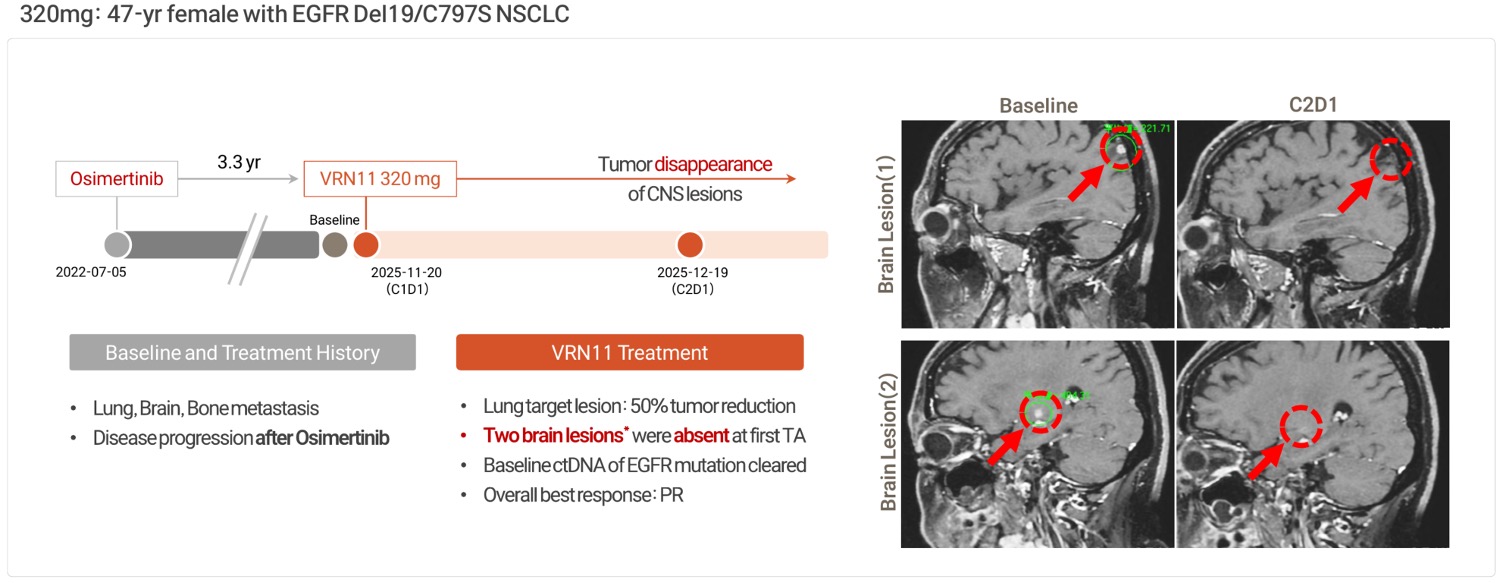
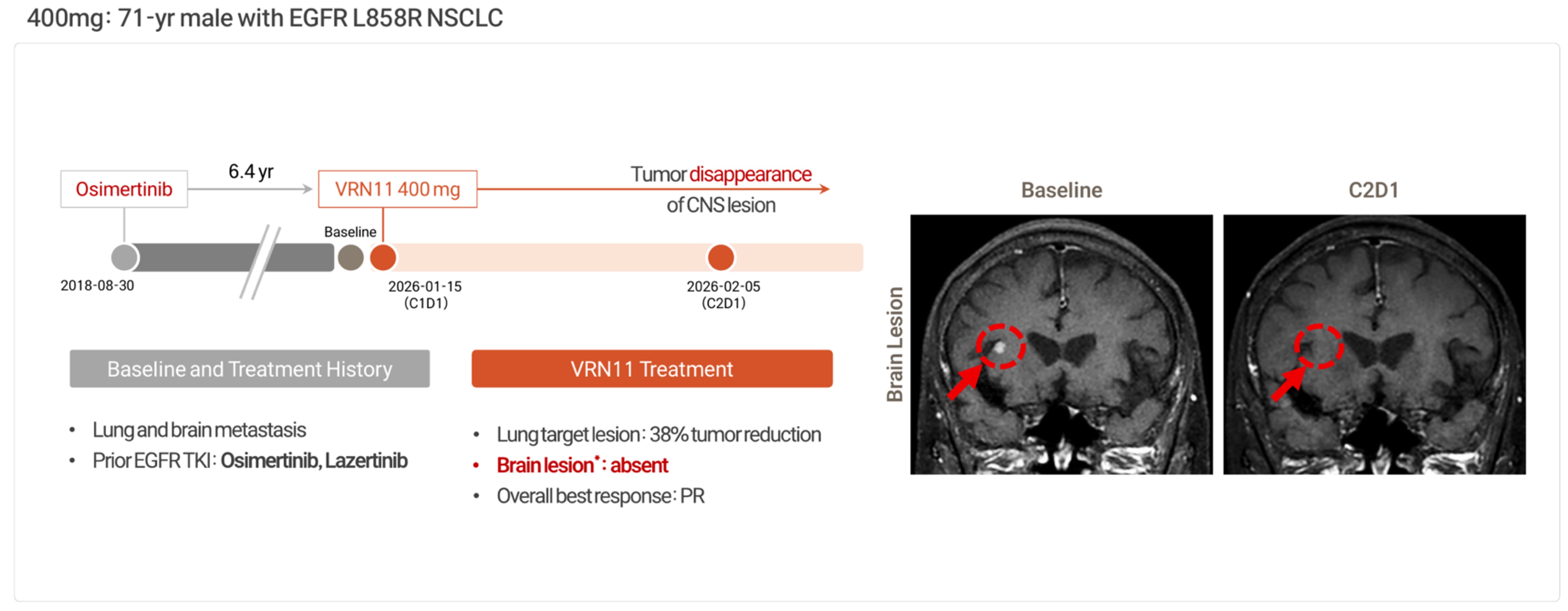
[Photo] Complete disappearance of brain lesions was confirmed in patients with brain metastases after third-generation treatment
■ Intracranial progression-free survival of 9 months or more (Not Reached), confirming clinical superiority over Tagrisso (3.5 months)
According to the ASCO data, in the trial of VRN11 in patients with brain metastases after treatment with the third-generation therapy Tagrisso, the median intracranial progression-free survival (median iPFS) was still NR (Not Reached) at the 9-month mark. By comparison, Tagrisso was reported to have an intracranial progression-free survival of 3.5 months in a trial of patients with brain metastases after treatment with first- or second-generation therapies.
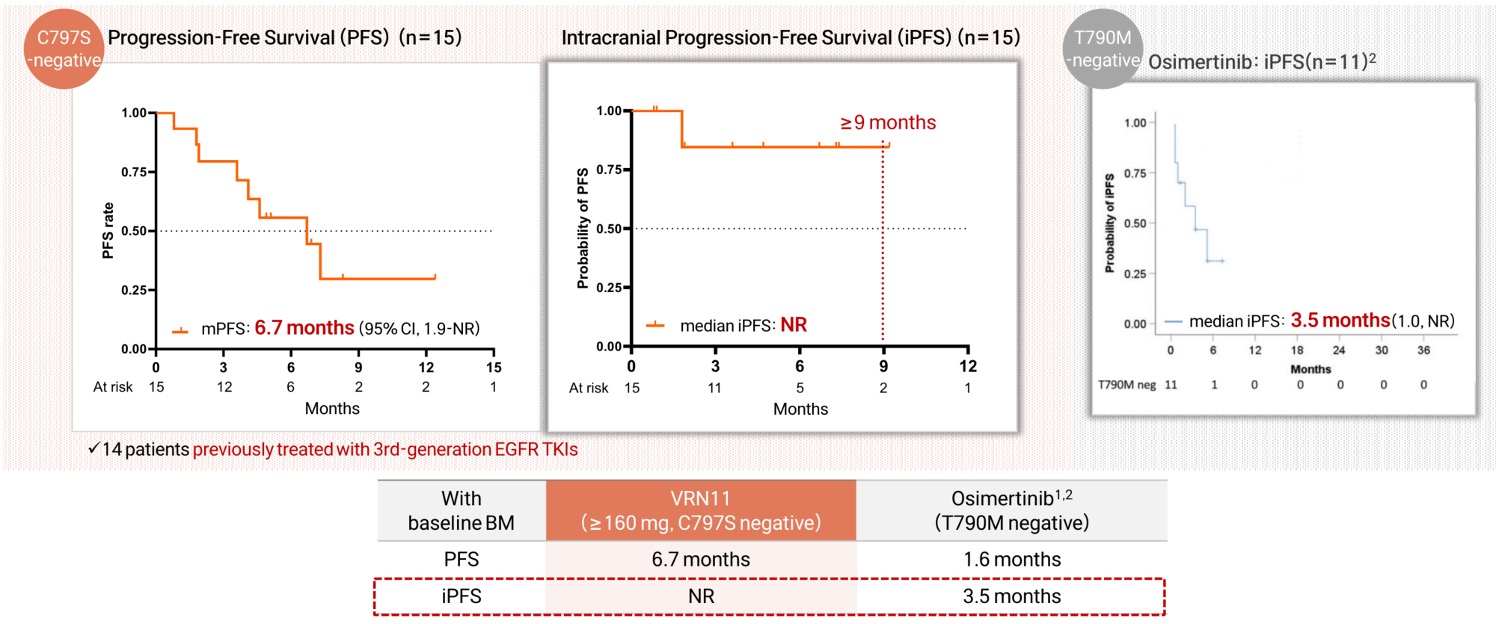
[Photo] Intracranial progression-free survival of 9 months or more (Not Reached), confirming clinical superiority over Tagrisso (3.5 months)
The VRN11 results are all the more meaningful in that they were confirmed in a difficult, heavily pretreated patient population with a more extensive treatment history and more advanced disease progression.
These results suggest VRN11's potential as a treatment option for patients with brain metastases, in that its efficacy was confirmed in the group of brain metastasis patients refractory to third-generation therapies.
■ CNS activity based on blood-brain barrier (BBB) penetration and target engagement
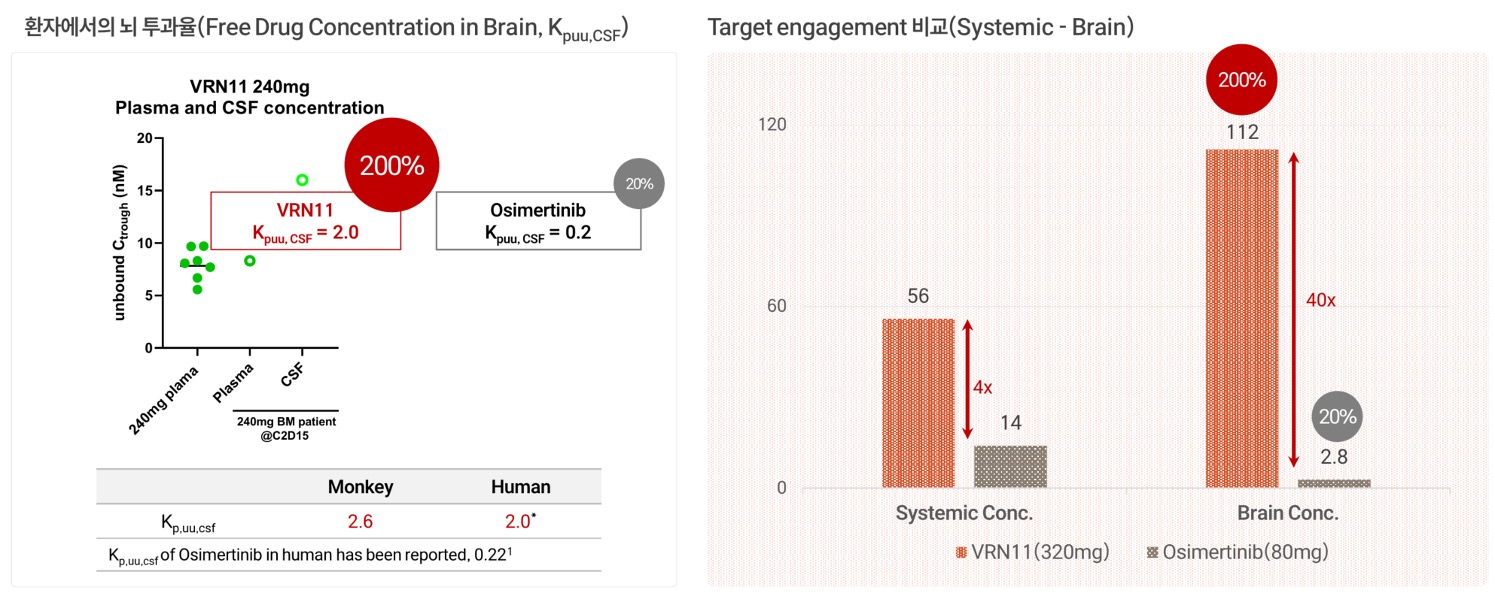
According to Voronoi, these results are based on VRN11's high blood-brain barrier (BBB) penetration and potent target engagement.
VRN11 has demonstrated brain penetration at the 200% level in patients, whereas Tagrisso is known to be at about 20%. In addition, VRN11 at the 320 mg dose demonstrated approximately four times higher target engagement than Tagrisso at 80 mg; taken together, the company explains, actual target engagement within the CNS may be far higher than that of Tagrisso. The company believes the difference could theoretically be as much as about 40-fold.
■ Targeting the EGFR brain metastasis market with high unmet need... Pursuing follow-on clinical and regulatory strategies
Based on the data presented at ASCO, Voronoi aims to form a separate cohort of patients with EGFR mutation brain metastases and to pursue accelerated approval through a Phase 2 trial.
Daekwon Kim, CEO of the Research Division of Voronoi, said, "A considerable proportion of EGFR lung cancer patients experience brain metastases, but the reality is that treatment options after Tagrisso are limited. Now that VRN11's differentiated brain penetration and CNS efficacy have been confirmed through clinical data, we plan to fully launch clinical development in patients with EGFR mutation brain metastases."
The industry is paying attention to the possibility that VRN11 will establish itself as a key contender among next-generation EGFR lung cancer therapies capable of overcoming the limitations of existing third-generation therapies.
Voronoi (310210) announced on the 1st that it has presented clinical data on 'VRN11,' its next-generation therapy for patients with EGFR mutation non-small cell lung cancer (NSCLC), at the American Society of Clinical Oncology Annual Meeting (ASCO), being held in Chicago, U.S., through the 4th (U.S. local time).
The most noteworthy part of the data is the strong tumor response confirmed in the group of patients with brain (CNS) metastases who had not responded to existing therapies.
■ No treatment options when brain metastases progress after Tagrisso... A representative area of unmet need
Brain metastases occur at a very high frequency in patients with EGFR mutation lung cancer, but after treatment with AstraZeneca's third-generation therapy 'Tagrisso (osimertinib),' currently used as the standard of care, there are no available treatment options. For this reason, it has been cited as a representative area of unmet need.
According to the NCCN (National Comprehensive Cancer Network) guidelines, which currently serve as the global standard for cancer treatment, when brain metastases occur during Tagrisso treatment, it is recommended to perform local treatment such as SRS (stereotactic radiosurgery) or WBRT (whole-brain radiotherapy), or to continue Tagrisso treatment in combination with surgery.
■ "Complete disappearance of brain lesions confirmed" in patients with brain metastases after third-generation treatment
VRN11 showed cases of brain lesion disappearance even at the low dose of 40 mg, with antitumor activity in the CNS observed starting from low doses.
In addition, two additional individual patient case studies were disclosed in the ASCO data. These patients all entered the trial with brain metastases that had progressed after third-generation EGFR therapy, and in both cases complete disappearance of the brain lesions was confirmed at the first tumor assessment.
[Photo] Complete disappearance of brain lesions was confirmed in patients with brain metastases after third-generation treatment
■ Intracranial progression-free survival of 9 months or more (Not Reached), confirming clinical superiority over Tagrisso (3.5 months)
According to the ASCO data, in the trial of VRN11 in patients with brain metastases after treatment with the third-generation therapy Tagrisso, the median intracranial progression-free survival (median iPFS) was still NR (Not Reached) at the 9-month mark. By comparison, Tagrisso was reported to have an intracranial progression-free survival of 3.5 months in a trial of patients with brain metastases after treatment with first- or second-generation therapies.
[Photo] Intracranial progression-free survival of 9 months or more (Not Reached), confirming clinical superiority over Tagrisso (3.5 months)
The VRN11 results are all the more meaningful in that they were confirmed in a difficult, heavily pretreated patient population with a more extensive treatment history and more advanced disease progression.
These results suggest VRN11's potential as a treatment option for patients with brain metastases, in that its efficacy was confirmed in the group of brain metastasis patients refractory to third-generation therapies.
■ CNS activity based on blood-brain barrier (BBB) penetration and target engagement
According to Voronoi, these results are based on VRN11's high blood-brain barrier (BBB) penetration and potent target engagement.
VRN11 has demonstrated brain penetration at the 200% level in patients, whereas Tagrisso is known to be at about 20%. In addition, VRN11 at the 320 mg dose demonstrated approximately four times higher target engagement than Tagrisso at 80 mg; taken together, the company explains, actual target engagement within the CNS may be far higher than that of Tagrisso. The company believes the difference could theoretically be as much as about 40-fold.
■ Targeting the EGFR brain metastasis market with high unmet need... Pursuing follow-on clinical and regulatory strategies
Based on the data presented at ASCO, Voronoi aims to form a separate cohort of patients with EGFR mutation brain metastases and to pursue accelerated approval through a Phase 2 trial.
Daekwon Kim, CEO of the Research Division of Voronoi, said, "A considerable proportion of EGFR lung cancer patients experience brain metastases, but the reality is that treatment options after Tagrisso are limited. Now that VRN11's differentiated brain penetration and CNS efficacy have been confirmed through clinical data, we plan to fully launch clinical development in patients with EGFR mutation brain metastases."
The industry is paying attention to the possibility that VRN11 will establish itself as a key contender among next-generation EGFR lung cancer therapies capable of overcoming the limitations of existing third-generation therapies.