
Voronoi Announces Interim Phase 1a Results for Next-Generation HER2 Solid Tumor Therapy 'VRN10'...
Anticancer Activity Confirmed in Post-Enhertu Patients and Patients with Brain Metastases
Anticancer Activity Confirmed in Post-Enhertu Patients and Patients with Brain Metastases
2026.06.02
■ Objective response rate (ORR) of 43% and disease control rate (DCR) of 86% in HER2-mutant patients
■ Anticancer activity confirmed even in patients who progressed after Enhertu treatment
■ Early CNS activity signal confirmed in patients with brain metastases
■ Excellent safety profile confirmed, with no severe hepatotoxicity or cardiotoxicity
Voronoi (310210) announced on the 2nd that it has presented interim Phase 1a results for 'VRN10,' its next-generation HER2 solid tumor targeted therapy, at the American Society of Clinical Oncology Annual Meeting (ASCO 2026).
The presentation included results from the ongoing Phase 1a dose-escalation trial in 35 patients with HER2-positive or HER2-mutant advanced solid tumors. The patients enrolled in the trial are a heavily treated population whose disease had progressed after multiple prior therapies, including HER2-targeted therapies.
In particular, meaningful anticancer activity was confirmed in the HER2-mutant patient group. In HER2-mutant patients, the objective response rate (ORR) was 43% and the disease control rate (DCR) was 86%, and a substantial number of patients are continuing long-term treatment. These results suggest that VRN10 can maintain antitumor activity in HER2-mutant solid tumors even after a variety of prior therapies.
It is also significant that clinical efficacy was confirmed in patients who had failed treatment with Enhertu (trastuzumab deruxtecan), which has become the standard of care for a variety of HER2-related solid tumors.
In the group of HER2-positive breast cancer patients with prior Enhertu treatment, the disease control rate (DCR) was 83%, and a partial response (PR) was also observed in a HER2-mutant lung cancer patient whose disease had progressed after Enhertu treatment. This is regarded as an early result demonstrating VRN10's potential for development as a post-Enhertu treatment option.
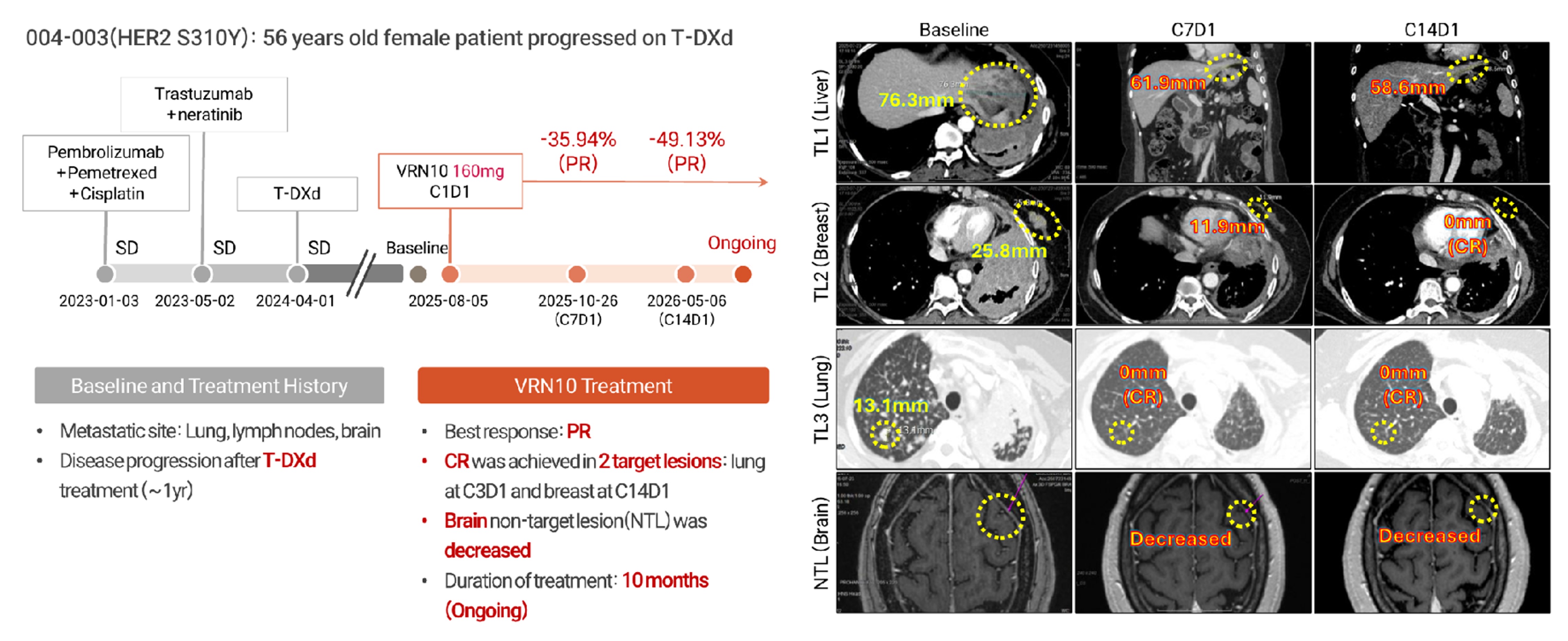
[Image description] Case of a HER2-mutant solid tumor patient with prior Enhertu treatment
Therapeutic effects in patients with brain metastases were also confirmed. Intracranial disease control was observed in 75% of evaluable patients with baseline brain metastases. In particular, in a HER2-mutant lung cancer patient who developed brain metastases after Enhertu treatment, a reduction in brain lesions was confirmed, and the patient has continued treatment for more than 10 months since starting therapy.
In terms of safety, the results were generally favorable. Dose escalation is currently proceeding up to 480 mg, and the maximum tolerated dose (MTD) has not yet been reached. The rate of Grade 3 or higher drug-related adverse events was around 6%, mostly diarrhea, and the severe hepatotoxicity and cardiotoxicity that are major concerns with existing HER2 inhibitors were not observed.
Voronoi is currently continuing dose escalation and plans to conduct a monotherapy expansion cohort in patients with solid tumors including HER2-activating mutation non-small cell lung cancer, as well as a Phase 1b trial of combination therapy with Enhertu and antibody therapeutics in HER2-positive solid tumors.
A Voronoi representative said, "These results show that VRN10 has clinical efficacy not only in HER2-mutant solid tumors but also in patients whose disease has progressed after Enhertu treatment. In particular, we expect the early CNS activity signal confirmed in patients with brain metastases to become an important differentiating factor in the clinical development process going forward."
■ Anticancer activity confirmed even in patients who progressed after Enhertu treatment
■ Early CNS activity signal confirmed in patients with brain metastases
■ Excellent safety profile confirmed, with no severe hepatotoxicity or cardiotoxicity
Voronoi (310210) announced on the 2nd that it has presented interim Phase 1a results for 'VRN10,' its next-generation HER2 solid tumor targeted therapy, at the American Society of Clinical Oncology Annual Meeting (ASCO 2026).
The presentation included results from the ongoing Phase 1a dose-escalation trial in 35 patients with HER2-positive or HER2-mutant advanced solid tumors. The patients enrolled in the trial are a heavily treated population whose disease had progressed after multiple prior therapies, including HER2-targeted therapies.
In particular, meaningful anticancer activity was confirmed in the HER2-mutant patient group. In HER2-mutant patients, the objective response rate (ORR) was 43% and the disease control rate (DCR) was 86%, and a substantial number of patients are continuing long-term treatment. These results suggest that VRN10 can maintain antitumor activity in HER2-mutant solid tumors even after a variety of prior therapies.
It is also significant that clinical efficacy was confirmed in patients who had failed treatment with Enhertu (trastuzumab deruxtecan), which has become the standard of care for a variety of HER2-related solid tumors.
In the group of HER2-positive breast cancer patients with prior Enhertu treatment, the disease control rate (DCR) was 83%, and a partial response (PR) was also observed in a HER2-mutant lung cancer patient whose disease had progressed after Enhertu treatment. This is regarded as an early result demonstrating VRN10's potential for development as a post-Enhertu treatment option.
[Image description] Case of a HER2-mutant solid tumor patient with prior Enhertu treatment
Therapeutic effects in patients with brain metastases were also confirmed. Intracranial disease control was observed in 75% of evaluable patients with baseline brain metastases. In particular, in a HER2-mutant lung cancer patient who developed brain metastases after Enhertu treatment, a reduction in brain lesions was confirmed, and the patient has continued treatment for more than 10 months since starting therapy.
In terms of safety, the results were generally favorable. Dose escalation is currently proceeding up to 480 mg, and the maximum tolerated dose (MTD) has not yet been reached. The rate of Grade 3 or higher drug-related adverse events was around 6%, mostly diarrhea, and the severe hepatotoxicity and cardiotoxicity that are major concerns with existing HER2 inhibitors were not observed.
Voronoi is currently continuing dose escalation and plans to conduct a monotherapy expansion cohort in patients with solid tumors including HER2-activating mutation non-small cell lung cancer, as well as a Phase 1b trial of combination therapy with Enhertu and antibody therapeutics in HER2-positive solid tumors.
A Voronoi representative said, "These results show that VRN10 has clinical efficacy not only in HER2-mutant solid tumors but also in patients whose disease has progressed after Enhertu treatment. In particular, we expect the early CNS activity signal confirmed in patients with brain metastases to become an important differentiating factor in the clinical development process going forward."