
Voronoi Presents Phase 1 Results of HER2-Targeted Anticancer Drug ‘VRN10’ at ESMO 2026
2026.10.26
■ Partial responses confirmed in HER2 non-TKD mutations, for which no approved targeted therapy exists
■ Tumor reduction also observed in HER2-positive patients and patients with brain metastases
Voronoi (310210) announced on the 26th that it presented Phase 1 clinical results of VRN10, its HER2-targeted anticancer drug, as a poster at the ESMO Congress 2026 (European Society for Medical Oncology annual meeting), held in Madrid, Spain, from October 23 to 27.
The presentation disclosed efficacy by HER2 mutation type, clinical results in HER2-positive patients, key patient cases, and safety data.
● Efficacy confirmed even in non-TKD mutations, for which no approved drug exists
Among 12 evaluable patients with HER2 mutations, partial response (PR) was observed in 2 of 5 patients (40%) with tyrosine kinase domain (TKD) mutations and in 3 of 7 patients (43%) with mutations outside the TKD (non-TKD).
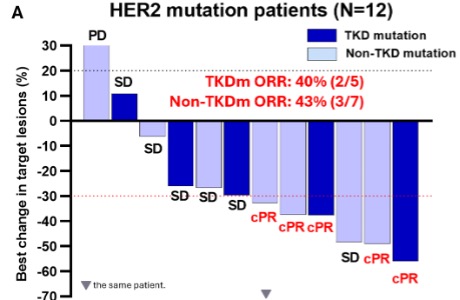
[Image caption] Waterfall plot of patients with HER2-mutant solid tumors
HER2 mutations are classified as TKD or non-TKD depending on where they occur. The indications of currently approved HER2-targeted therapies are limited to TKD mutations, and no approved therapy exists for HER2 non-TKD mutations. Notably, partial response was confirmed in all 3 patients (100%) with HER2-mutant non-small cell lung cancer.
● Efficacy also confirmed in HER2-positive patients, including those previously treated with an ADC
Among 18 HER2-positive patients (protein overexpression or gene amplification), partial response was confirmed in 3 (17%) and stable disease (SD) was observed in 10, confirming a high disease control rate (DCR).
Also, 17 of the 30 evaluable patients had previously received Enhertu (T-DXd), a HER2-targeted ADC. Patients whose disease progressed after ADC treatment have limited follow-up treatment options, so it is notable that VRN10 showed antitumor effects in the group with that treatment history.
● Tumor reduction in patients with brain metastases, with dosing continuing at 10.6 months
The presentation also disclosed clinical cases observed in patients with brain metastases.
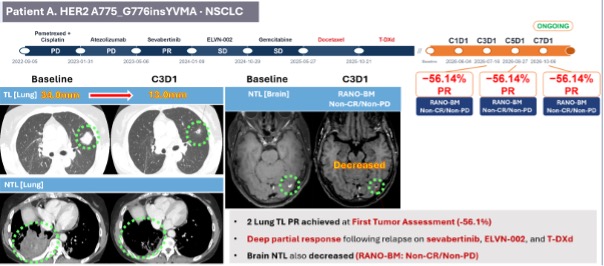
[Image caption] Case of a non-small cell lung cancer patient with a HER2 mutation (A775_G776insYVMA)
A non-small cell lung cancer patient with a HER2 mutation (A775_G776insYVMA) received VRN10 after failing a total of 7 prior treatments, including Enhertu. At the first tumor assessment, the lung lesion had shrunk by 56.1%, reaching partial response. The size of the brain lesion was also confirmed to have decreased.
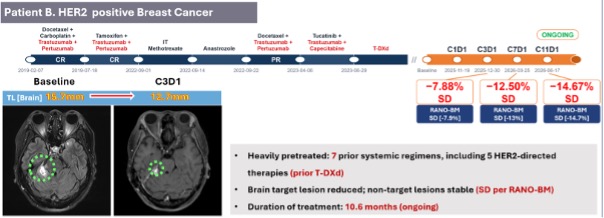
[Image caption] Case of a HER2-positive breast cancer patient
Another HER2-positive breast cancer patient had not achieved a sufficient treatment effect on brain lesions despite a total of 7 prior treatments. After VRN10 administration, a reduction in the brain lesion was observed, and the patient continues dosing at 10.6 months.
Efficacy against brain metastases was also confirmed in animal studies. Antitumor effects were observed in an intracranial tumor transplant model, and the brain penetration measured in mice (Kp,uu,CSF) was 1 or higher.
● Grade 3 or higher adverse events at 6%; maximum tolerated dose (MTD) not reached
Among 50 patients in the safety evaluation, grade 3 or higher adverse events were reported in 3 (6%). The most common adverse event was diarrhea, occurring in 26 patients (52%), and it was managed effectively with loperamide as needed. The maximum tolerated dose has not been reached so far, and dose escalation is ongoing up to the 560 mg cohort.
A Voronoi representative said, "Based on the encouraging clinical results confirmed in this trial, we will continue dose escalation to determine the recommended Phase 2 dose (RP2D), and then run a monotherapy cohort for HER2-mutant non-small cell lung cancer and a combination therapy cohort for HER2-positive solid tumors in Phase 1b."
■ Tumor reduction also observed in HER2-positive patients and patients with brain metastases
Voronoi (310210) announced on the 26th that it presented Phase 1 clinical results of VRN10, its HER2-targeted anticancer drug, as a poster at the ESMO Congress 2026 (European Society for Medical Oncology annual meeting), held in Madrid, Spain, from October 23 to 27.
The presentation disclosed efficacy by HER2 mutation type, clinical results in HER2-positive patients, key patient cases, and safety data.
● Efficacy confirmed even in non-TKD mutations, for which no approved drug exists
Among 12 evaluable patients with HER2 mutations, partial response (PR) was observed in 2 of 5 patients (40%) with tyrosine kinase domain (TKD) mutations and in 3 of 7 patients (43%) with mutations outside the TKD (non-TKD).
[Image caption] Waterfall plot of patients with HER2-mutant solid tumors
HER2 mutations are classified as TKD or non-TKD depending on where they occur. The indications of currently approved HER2-targeted therapies are limited to TKD mutations, and no approved therapy exists for HER2 non-TKD mutations. Notably, partial response was confirmed in all 3 patients (100%) with HER2-mutant non-small cell lung cancer.
● Efficacy also confirmed in HER2-positive patients, including those previously treated with an ADC
Among 18 HER2-positive patients (protein overexpression or gene amplification), partial response was confirmed in 3 (17%) and stable disease (SD) was observed in 10, confirming a high disease control rate (DCR).
Also, 17 of the 30 evaluable patients had previously received Enhertu (T-DXd), a HER2-targeted ADC. Patients whose disease progressed after ADC treatment have limited follow-up treatment options, so it is notable that VRN10 showed antitumor effects in the group with that treatment history.
● Tumor reduction in patients with brain metastases, with dosing continuing at 10.6 months
The presentation also disclosed clinical cases observed in patients with brain metastases.
[Image caption] Case of a non-small cell lung cancer patient with a HER2 mutation (A775_G776insYVMA)
A non-small cell lung cancer patient with a HER2 mutation (A775_G776insYVMA) received VRN10 after failing a total of 7 prior treatments, including Enhertu. At the first tumor assessment, the lung lesion had shrunk by 56.1%, reaching partial response. The size of the brain lesion was also confirmed to have decreased.
[Image caption] Case of a HER2-positive breast cancer patient
Another HER2-positive breast cancer patient had not achieved a sufficient treatment effect on brain lesions despite a total of 7 prior treatments. After VRN10 administration, a reduction in the brain lesion was observed, and the patient continues dosing at 10.6 months.
Efficacy against brain metastases was also confirmed in animal studies. Antitumor effects were observed in an intracranial tumor transplant model, and the brain penetration measured in mice (Kp,uu,CSF) was 1 or higher.
● Grade 3 or higher adverse events at 6%; maximum tolerated dose (MTD) not reached
Among 50 patients in the safety evaluation, grade 3 or higher adverse events were reported in 3 (6%). The most common adverse event was diarrhea, occurring in 26 patients (52%), and it was managed effectively with loperamide as needed. The maximum tolerated dose has not been reached so far, and dose escalation is ongoing up to the 560 mg cohort.
A Voronoi representative said, "Based on the encouraging clinical results confirmed in this trial, we will continue dose escalation to determine the recommended Phase 2 dose (RP2D), and then run a monotherapy cohort for HER2-mutant non-small cell lung cancer and a combination therapy cohort for HER2-positive solid tumors in Phase 1b."